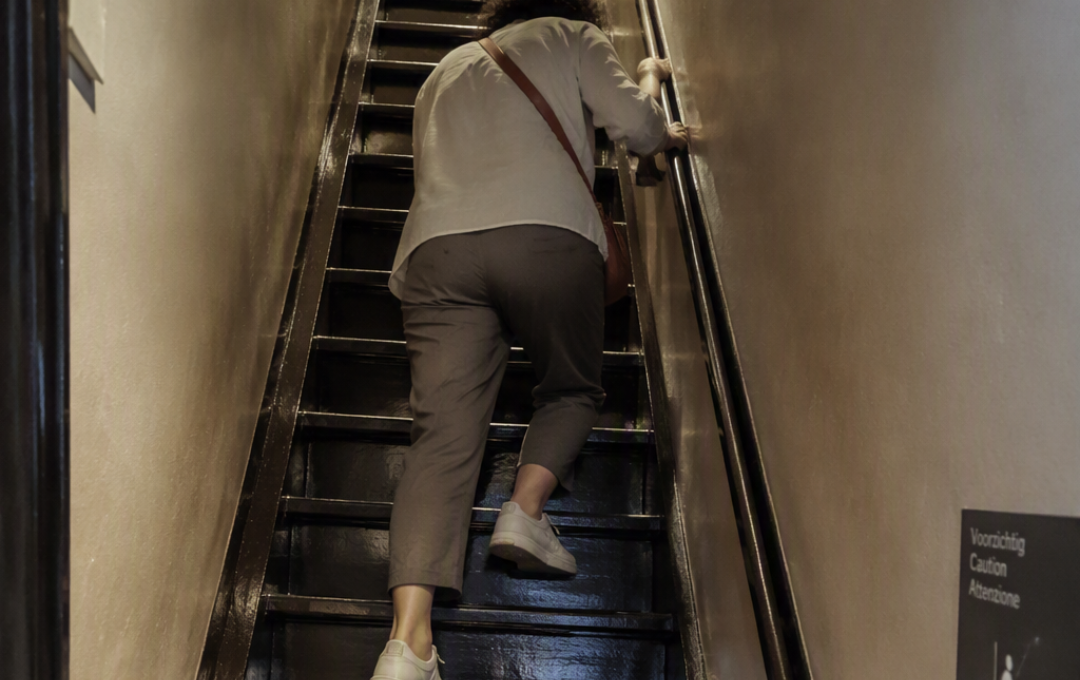
If you notice more pain in your knees when using the stairs, you are not alone. Stair climbing can place two to three times your body weight on the knee joint, far more than walking on level ground. That dramatic increase in load is what makes stairs such a reliable trigger for knee pain, even when the same knee feels fine during a casual walk.
Whether your knee hurts going up, coming down, or both, several underlying conditions could be responsible, including joint degeneration, soft tissue injuries, and even circulation problems. Understanding what triggers your symptoms is an important first step toward finding the right treatment.
How Stair Climbing Affects Your Knees
Stair climbing makes your knees bend repeatedly while supporting your full body weight. As your knee bends, the patella (kneecap) tracks along a groove in the femur (thigh bone). When that tracking is off, or when the cartilage cushioning the joint has thinned, the pressure generated during this motion becomes painful.
Because the muscles around the knee work significantly harder on stairs than on flat ground, any existing irritation, weakness, or structural problem in the joint becomes more noticeable. That is why a knee that feels tolerable during a walk may protest sharply the moment you hit the first step.
Common Causes of Knee Pain When Climbing Stairs
Several conditions can cause knee problems while climbing stairs. When and where your symptoms occur may provide clues about the underlying cause.
Knee Osteoarthritis
Knee osteoarthritis occurs when the cartilage within the knee joint gradually deteriorates, reducing the cushioning between bones. As cartilage thins, the increased load of stair climbing can cause significant pain. Common symptoms include pain going up or down stairs, swelling, stiffness (especially in the morning), reduced range of motion, and grinding or clicking sensations. Symptoms tend to worsen gradually over time.
An imaging study such as an X-ray or MRI, combined with a physical examination, is typically needed to confirm osteoarthritis and assess its severity.
Patellofemoral Pain Syndrome (Runner’s Knee)
Patellofemoral pain syndrome, commonly called runner’s knee, causes discomfort around or behind the kneecap and can affect people who do not run at all. The pain is often most noticeable during repetitive knee bending, such as climbing stairs or rising after sitting for an extended period. It typically results from muscle imbalances, poor patellar tracking, or overuse rather than a structural injury, which means it often responds well to targeted physical therapy.
Tendon or Ligament Injuries
The tendons and ligaments surrounding your knee help stabilize the joint during movement. Overuse, repetitive stress, sports injuries, or sudden movements can damage these tissues. Patellar tendinitis, also known as jumper’s knee, affects the tendon connecting the kneecap to the shinbone and commonly causes pain during stair climbing. Ligament injuries can also produce swelling, instability, and difficulty bearing weight. A physical exam, and sometimes an MRI, is needed to distinguish tendon and ligament injuries from other causes.
Meniscus Tears
The menisci are two pieces of cartilage that cushion and stabilize the knee joint. A meniscus can tear following a twisting injury or gradually weaken with age. Because stair climbing requires greater bending and weight-bearing than flat walking, a torn or damaged meniscus often makes stairs particularly uncomfortable. Symptoms may include pain, swelling, stiffness, a catching or locking sensation, and difficulty fully bending or straightening the leg. MRI imaging is the most reliable way to confirm a meniscus tear.
Poor Circulation or Peripheral Artery Disease (PAD)
Not every type of leg pain during activity comes from the knee joint itself. Peripheral artery disease (PAD) occurs when narrowed arteries reduce blood flow to the legs. During physical exertion, working muscles demand more oxygen-rich blood than the narrowed arteries can deliver, which triggers pain.
PAD commonly causes muscle pain, aching, cramping, heaviness, or fatigue that improves with rest. While this discomfort frequently occurs in the calves, thighs, or buttocks, it can be mistaken for knee pain. Additional PAD symptoms may include coldness in one foot or leg, skin color changes, slow-healing wounds, or decreased hair growth on the legs.
Because so many conditions can cause knee pain on stairs, the only reliable way to know what is behind yours is a professional evaluation. A specialist can pinpoint the cause and rule out vascular conditions like PAD.
Knee Pain Going Up Stairs vs. Walking Down Stairs
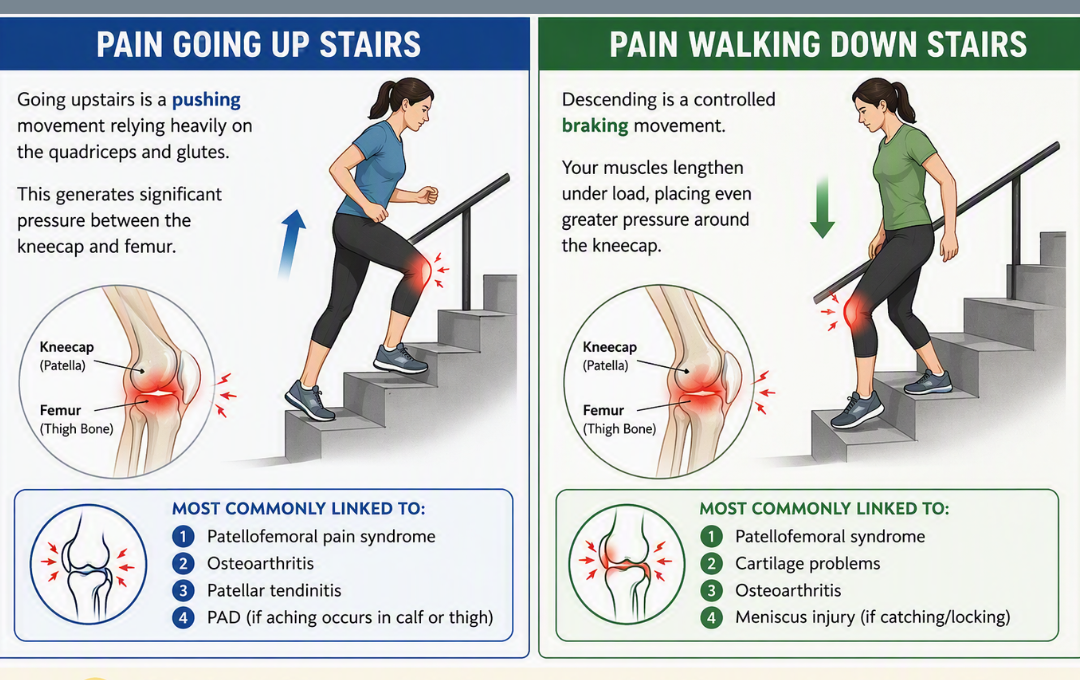
Knee pain going up and down stairs does not always feel the same in both directions because the two movements recruit different muscles and distribute load differently across the joint. Paying attention to which direction triggers your pain can offer useful diagnostic clues.
Pain When Going Up Stairs
Going upstairs is a pushing movement that relies heavily on the quadriceps and glutes to lift your body weight onto the next step. This generates significant pressure between the kneecap and the femur. Pain on the way up is most commonly linked to patellofemoral pain syndrome, osteoarthritis, or patellar tendinitis, all of which are aggravated by the compressive force the quadriceps place on the kneecap during the push phase.
If going upstairs consistently produces aching, cramping, or heaviness in the calf or thigh rather than localized knee pain, a vascular condition such as PAD may need to be ruled out, as those symptoms reflect muscle-level oxygen demand rather than joint stress.
Pain When Walking Down Stairs
Descending stairs is a controlled braking movement. Your quadriceps and surrounding muscles work eccentrically, meaning they lengthen under load, to slow your body’s descent while your knee remains bent. This places even greater pressure around the kneecap than going up does, which is why many people find descending stairs more painful than ascending.
Pain walking down stairs is more commonly associated with patellofemoral syndrome, cartilage problems, and osteoarthritis. If the pain is sharp and accompanied by a catching or locking sensation, a meniscus injury may be the more likely cause.
How to Relieve Knee Pain When Climbing Stairs
Treating knee pain when walking up and down stairs depends on what is causing your symptoms. Options range from simple at-home care to minimally invasive medical treatments.
At-Home Care
Mild pain related to overuse may improve with the following measures:
- Ice therapy: Apply an ice pack wrapped in a cloth to the affected knee for 15 to 20 minutes after activity to reduce inflammation.
- Strengthening exercises: Quad sets, straight leg raises, and wall sits help build the muscle support around the knee without placing excessive joint stress. Stronger quadriceps take load off the kneecap.
- Flexibility work: Gentle hamstring and calf stretching reduces tension that can pull on the knee joint during movement.
- Supportive footwear: Well-cushioned shoes with adequate arch support reduce the shock transmitted to the knee with each step.
- Low-impact activity: Swimming and cycling maintain fitness and circulation without the repetitive knee impact of running or stair climbing.
Medical Treatments
If symptoms persist after at-home care, a knee specialist may recommend physical therapy, anti-inflammatory medications, corticosteroid injections, or minimally invasive procedures. One option worth knowing about is genicular artery embolization (GAE), a non-surgical procedure that reduces blood flow to the inflamed lining of the knee joint, thereby decreasing pain associated with mild to moderate osteoarthritis. Vascular conditions such as PAD require a separate treatment approach focused on improving circulation and reducing cardiovascular risk.
When Surgery May Be Needed
Surgery is generally considered when conservative treatments have not provided adequate relief and joint damage is extensive. Not everyone with knee pain will need surgery. Minimally invasive options like GAE can address pain effectively in appropriate candidates, particularly those with less advanced osteoarthritis who are not yet candidates for joint replacement.
Explore Non-Surgical Treatment
When Should I See a Doctor for Knee Pain on Stairs?
Occasional mild soreness after physical activity may improve with rest, but persistent or worsening pain deserves medical evaluation. Consult a knee pain specialist if your pain:
- Lasts for several weeks without improvement
- Interferes with everyday activities like climbing stairs, walking, or standing
- Comes with significant swelling, instability, or limited mobility
- Occurred following a fall, collision, or sudden twisting injury
- Makes it difficult to bear weight on the affected leg
If you experience recurring leg cramping, aching, heaviness, or fatigue during activity that relieves with rest, you may also benefit from a vascular evaluation. At USA Pain Center, our specialists can assess both joint and circulation-related causes of leg pain, so you do not need to visit multiple practices to get answers.
Get Answers About Your Knee Pain
Whether your symptoms are related to arthritis, injury, inflammation, or circulation issues, an accurate diagnosis is essential for proper treatment. Our experienced knee pain specialists can help determine the cause of your symptoms and recommend appropriate, minimally invasive treatment options based on your needs.
FAQs About Knee Pain When Climbing Stairs
How do I stop knee pain when climbing stairs?
The right approach depends on the cause. For mild overuse pain, rest, ice applied for 15 to 20 minutes after activity, and low-impact strengthening exercises such as quad sets or straight leg raises can help. If pain persists, a doctor can identify the underlying cause and recommend targeted treatments such as physical therapy, injections, or a minimally invasive procedure like GAE.
How do I tell if knee pain is arthritis?
Arthritis-related knee pain is often accompanied by stiffness (particularly in the morning or after periods of inactivity), swelling, reduced range of motion, and grinding or clicking sensations during movement. However, these symptoms can overlap with other conditions. An X-ray or MRI, along with a clinical examination, is needed to confirm an arthritis diagnosis and determine its severity. If you suspect arthritis, a knee specialist can give you a definitive answer rather than leaving you guessing.
At what age do knee problems start?
Knee problems can occur at any age, though the typical causes differ by life stage. Sports injuries, overuse conditions like patellofemoral pain syndrome, and ligament tears are more common in younger adults and athletes. Osteoarthritis, the most common form of knee arthritis, typically becomes more prevalent after age 45 to 50, though it can develop earlier in people with previous knee injuries, excess body weight, or occupations that place repetitive stress on the joint.
When should I see a doctor for knee pain on stairs?
See a doctor if your knee pain lasts more than a few weeks, worsens over time, follows a significant injury, or is accompanied by swelling, instability, or difficulty bearing weight. Pain that limits your ability to climb stairs or perform daily activities is also a good reason to seek evaluation rather than waiting.
Why does my knee hurt climbing stairs but not when walking?
Stair climbing places two to three times your body weight on the knee joint, significantly more than level walking. It also requires greater knee flexion and more forceful quadriceps engagement, which increases the pressure between the kneecap and the femur. If you have an underlying joint issue, soft tissue irritation, or cartilage loss, that extra load is often enough to trigger pain even when everyday walking feels manageable.