Medically reviewed byUSA Pain Center Medical Review TeamInterventional radiologists focused on knee osteoarthritis
Genicular artery embolization (GAE) is an advanced, minimally invasive outpatient procedure designed to relieve chronic knee pain by reducing excessive blood flow and inflammation within the joint capsule. For individuals living with moderate to severe knee osteoarthritis, GAE offers an effective alternative that restores mobility without the trauma or extended rehabilitation of major surgery.
If severe knee pain is limiting your ability to walk, climb stairs, or remain active, understanding the science behind genicular artery embolization can help you make an informed decision alongside a specialized physician. Our goal at USA Pain Center is ensure our patients feel educated and confident in their knee pain treatment decisions and we align them with the best option for effective relief of their OA symptoms with GAE.
Understanding Knee Osteoarthritis and Joint Inflammation
Knee osteoarthritis is a degenerative joint disease characterized by the breakdown of protective articular cartilage. As this natural cushioning deteriorates, bone surfaces rub together, producing localized friction, aching stiffness, swelling, and reduced physical mobility.
Mechanical wear is only one component of the disease process. Chronic irritation triggers synovitis, an inflammation of the synovial membrane lining the joint capsule. To sustain this inflammation, the body produces an overgrowth of tiny, abnormal microvessels (angiogenesis or hypervascularity) accompanied by sensitized sensory nerve fibers. This abnormal vascular network amplifies pain signals and accelerates joint discomfort.
While aging naturally wears down joint cartilage, repetitive impact, previous injuries, and body weight also accelerate osteoarthritis symptom progression. Addressing both mechanical irritation and underlying vascular inflammation is crucial for lasting relief.
What Is Genicular Artery Embolization (GAE)?
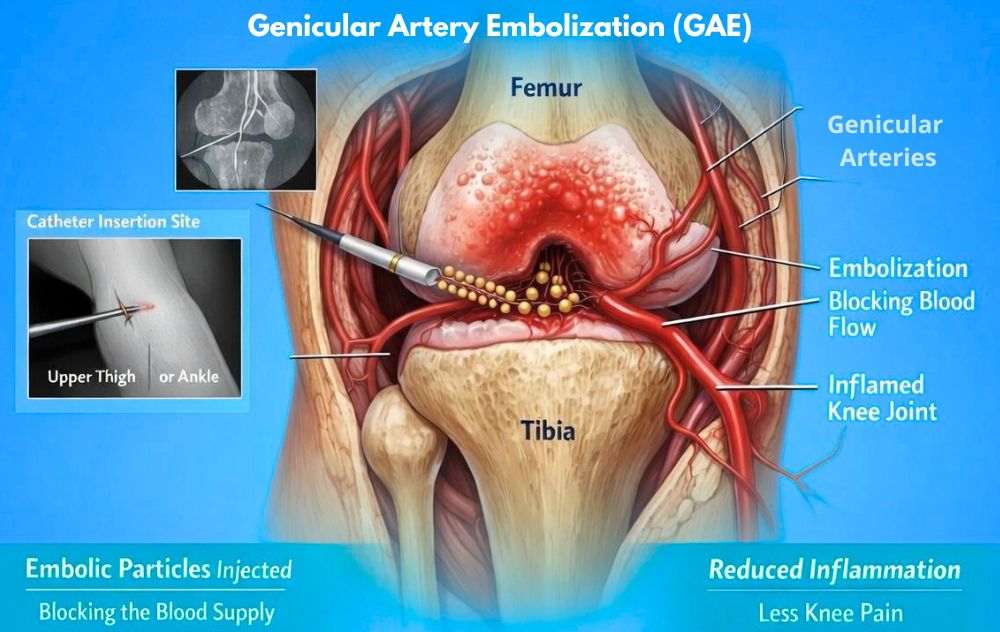
Genicular artery embolization is an image-guided medical procedure performed by an interventional radiologist to treat persistent knee osteoarthritis pain. By selectively blocking abnormal arterial branches feeding the inflamed synovial tissue, GAE calms hypervascularity and significantly reduces chronic inflammation.
In summary, GAE targets the abnormal, overactive microvessels (neovascularity) that grow into the knee’s joint lining (synovium) during osteoarthritis. By blocking these abnormal vessels with tiny microspheres, GAE calms down chronic inflammation (synovitis) and synovial thickening
Unlike total knee replacement surgery, GAE requires no open incisions, no bone resection, and no overnight hospital stay. It is an ideal middle-ground therapy for patients who have exhausted conservative therapies like NSAIDs, physical therapy, and cortisone shots, but want to explore non-surgical solutions before considering major surgery. Reviewing our comprehensive comparison of GAE compared with surgical options provides detailed insight into these approaches.
How the GAE Procedure Works Step by Step
GAE directly targets the genicular arteries surrounding the knee, neutralizing the microscopic vessels that sustain tissue inflammation.
1. Vascular Access
After administering local numbing medicine and mild intravenous sedation, the interventional radiologist makes a tiny pinhole access point in the wrist or upper thigh to introduce a miniature catheter.
2. Fluoroscopic Navigation
Using real-time X-ray fluoroscopy and contrast dye, the specialist precisely steers the microcatheter through the vascular system directly into the genicular branches feeding the inflamed knee joint.
3. Targeted Embolic Delivery
Microscopic embolic beads are released through the catheter to close down the abnormally proliferating capillaries while leaving healthy blood supply to bone and muscle intact. This halts the inflammatory cycle and relieves pain.
Key Benefits of Genicular Artery Embolization
Patients seeking alternatives to major orthopedics choose GAE for several distinct advantages:
- Minimally invasive: The entire treatment requires only a microscopic skin puncture, avoiding surgical incisions, stitches, and structural tissue disruption.
- No general anesthesia: Performed with gentle twilight sedation and local numbing, eliminating the risks and cognitive side effects of general anesthesia.
- Convenient outpatient care: Patients walk out of the medical center the same day to recover in the comfort of home.
- Rapid recovery: Most patients resume normal daily routines within 24 to 48 hours.
- Targeted symptom relief: By shutting down inflammatory hypervascularity, GAE delivers meaningful, sustained decreases in knee stiffness and tenderness.
- Preserved knee anatomy: Because no bone, cartilage, or ligaments are cut, your native anatomy remains untouched, leaving future medical options open.
Comparing Knee Osteoarthritis Treatments
Review how genicular artery embolization compares directly to temporary joint injections and total surgical replacement:
| Treatment | Invasiveness and Setting | Typical Recovery | Mechanism of Action |
|---|---|---|---|
| GAE (Genicular Artery Embolization) | Minimally invasive outpatient; local numbing and mild sedation | 1 to 2 days for everyday activities | Embolizes excessive vessels to reduce synovial inflammation |
| Joint Injections (Steroid / HA) | Non-surgical in-office needle injection | Immediate to 24 hours | Provides temporary chemical lubrication or masking; requires frequent repetition |
| Total Knee Replacement (TKA) | Major inpatient surgery; general anesthesia and hospitalization | 3 to 6 months of intense physical therapy | Surgically cuts bone and replaces the joint with metal and plastic implants |
Clinical Effectiveness and GAE Success Rates
Medical research strongly validates the therapeutic impact of genicular artery embolization. A meta-analysis analyzing 270 patients across 339 treated knees verified a 99.7 percent technical success rate for the procedure.[1] Patients documented statistically significant reductions in Visual Analog Scale (VAS) pain levels and Western Ontario and McMaster Universities Osteoarthritis Index (WOMAC) disability scores, maintaining benefits at 12-month checkups.
Longitudinal clinical trial data confirms that patients experiencing improvement at 12 months regularly maintain pain reductions at 24 months.[2] If symptoms recur as natural joint wear progresses over the years, GAE can be safely repeated.
Explore additional clinical timelines in our guide to how long GAE results typically last.
What to Expect During GAE Recovery
Post-procedure recovery after genicular artery embolization is direct and manageable. Following a short observation period in our recovery suite, you return home on the same day.
Mild stiffness or slight bruising near the pinhole entry site can occur over the initial 24 to 48 hours and responds well to standard ice packs and over-the-counter pain medication. Most individuals resume walking and light household tasks within a couple of days, while vigorous gym workouts and high-impact sports should be paused for roughly one week.
Safety Profile and Potential Side Effects
GAE demonstrates an exceptional safety record. Peer-reviewed evaluations show minor, self-limiting reactions are rare and resolve spontaneously:[1]
- Temporary skin blanching or redness around the knee, occurring in roughly 11.6 percent of patients and resolving quickly without intervention
- Transient post-procedure soreness, reported in approximately 1.2 percent of cases
- Mild puncture site bruising or small hematoma, seen in 0.6 percent of treatments
- Superficial skin irritation, appearing in 0.3 percent of patients
There were no major adverse events reported in these published cohorts, but ensuring you ask your specialist if they have any concerns or updated knowledge of adverse events is encouraged. Your doctor will review your medical history and answer every question prior to scheduling.
Are You a Candidate for Genicular Artery Embolization?
GAE is engineered for patients suffering from mild to severe knee osteoarthritis who have found insufficient relief from conservative therapies. You may be a candidate if you:
- Experience chronic knee pain, tenderness, or swelling limiting daily mobility
- Receive diminishing relief from physical therapy, NSAIDs, or cortisone and hyaluronic acid injections
- Wish to avoid or postpone total knee replacement surgery
- Are medically ineligible for open joint surgery due to health complications
- Prefer an outpatient procedure without general anesthesia or extensive downtime
Learn more by reviewing our guide to knee osteoarthritis symptoms, or check our overview of insurance coverage for GAE to verify your plan benefits.
Knee Pain Evaluation
Ready to Find Relief from Chronic Knee Pain with Genicular Artery Embolization?
Do not let joint pain restrict your quality of life. The interventional radiologists at USA Pain Center specialize in genicular artery embolization, using cutting-edge fluoroscopic technology to address joint inflammation at the source.
Schedule your comprehensive consultation today to evaluate your knee pain and explore customized treatment options.
Frequently Asked Questions About GAE
About the USA Pain Centers Medical Review Team
This article was medically reviewed by the USA Pain Center Medical Review Team, a dedicated group of interventional radiologists and clinical pain specialists focused on delivering minimally invasive therapies for knee osteoarthritis and chronic joint conditions.
Our clinical team regularly audits procedural literature, clinical outcome registries, and technique protocols to provide accurate, reliable healthcare education for prospective patients.
References
- Taslakian B, Miller LE, Mabud TS, et al. Genicular artery embolization for treatment of knee osteoarthritis pain: systematic review and meta-analysis. Osteoarthritis and Cartilage Open. 2023;5:100342.
- Padia SA, Genshaft S, Blumstein G, et al. Genicular artery embolization for treatment of symptomatic knee osteoarthritis: 2-year outcomes from a prospective IDE trial. Journal of Vascular and Interventional Radiology. 2024.