
Reviewed by
USA Clinics Medical Review Team
Reviewed: July 2026
Cortisone injections can provide temporary knee pain relief lasting from a few weeks to several months, but they’re not a long-term solution for knee osteoarthritis. If you’re considering a cortisone shot for knee pain or have already had one, understanding how long the relief typically lasts, what risks exist, and what alternatives are available can help you make an informed decision about your care.
This guide answers the most common patient questions about cortisone injections for knee osteoarthritis, helping you understand when they work, when they don’t, and what your next steps might be.
What Is a Cortisone Shot and How Does It Work?
Cortisone injections are a common treatment for knee pain caused by osteoarthritis. A corticosteroid (a powerful anti-inflammatory medication) is injected directly into the knee joint space. The medication works by suppressing your immune system’s inflammatory response, reducing swelling and the pain that inflammation causes.
Most cortisone injections combine the steroid with an anesthetic like lidocaine. The lidocaine provides immediate pain relief, while the corticosteroid (often triamcinolone) takes a few days to build its anti-inflammatory effect.
How Soon Do You Feel Relief?
You may feel immediate pain relief from the anesthetic portion of the injection, sometimes within hours. However, the steroid’s full anti-inflammatory effect typically begins within 2 to 5 days, with maximum pain reduction usually achieved within 1 to 2 weeks post-injection.
How Long Do Cortisone Shots Last? The Real Timeline
Understanding the realistic timeline for cortisone shot relief is critical for setting expectations and planning your treatment strategy.
Peak Effectiveness (4 to 12 Weeks)
For most patients, cortisone injections reach peak pain-reduction effectiveness around 4 to 12 weeks post-injection. Research shows that cortisone injections typically provide meaningful pain relief for 6 to 12 weeks in most patients, though the range is much wider.
Why Duration Varies Between Patients
How long cortisone works depends on several factors: severity of your osteoarthritis, your activity level, body weight, individual metabolism, and steroid dose. Higher-dose injections may provide longer-lasting effects.
Can You Get Multiple Cortisone Shots? Frequency and Safety Limits
If cortisone shots help, you might wonder whether you can get another one when relief wears off. The answer is yes, but there are important limits.
How Many Shots Per Year Are Safe?
Medical consensus is clear: Maximum 3 to 4 injections per year in the same knee joint, with at least 6 to 12 weeks between injections. Major organizations, including the Mayo Clinic and the National Institutes of Health (NIH), recommend this standard. Repeated injections that fail to provide lasting relief may signal it’s time to discuss other options with your doctor.
What Are the Risks and Side Effects of Cortisone Injections?
Like any medical procedure, cortisone injections carry both temporary and potential long-term risks.
Immediate Side Effects (Days 1 to 2)
About 10 to 15% of patients experience increased pain and swelling 24 to 48 hours after injection (post-injection flare). Injection site discomfort, pain, swelling, or bruising is common and typically mild, resolving within a few days.
Long-Term Risks With Repeated Use
Important: The most significant concern with repeated cortisone injections is cumulative joint damage. Cartilage thinning accelerates with steroid exposure, tendon weakening increases with repetition, and joint degeneration progresses faster than in untreated osteoarthritis based on imaging studies.
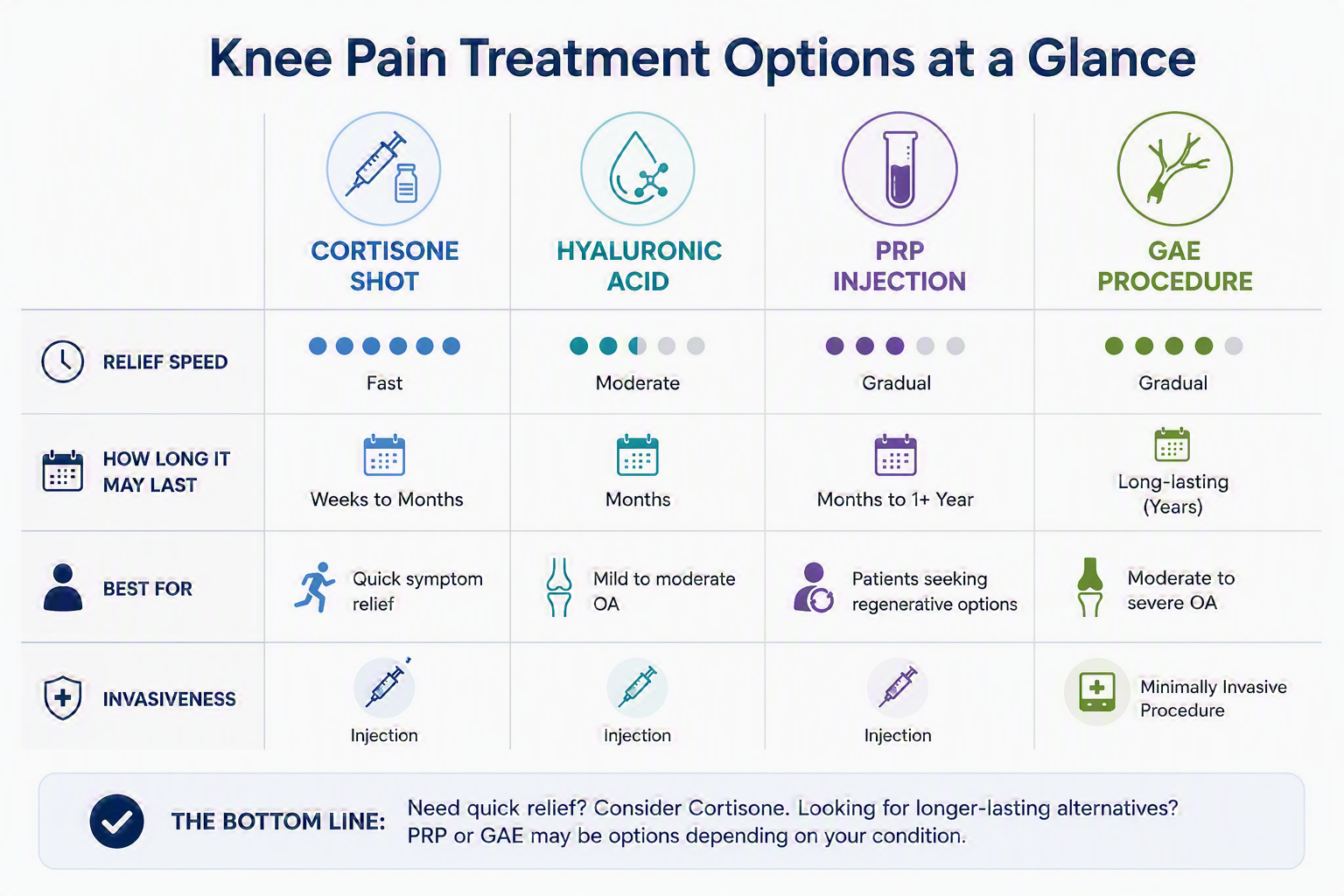
Alternatives to Cortisone Shots: Understanding the Options
If cortisone injections aren’t providing lasting relief, multiple evidence-based alternatives exist.
Hyaluronic Acid (Gel Shots)
Hyaluronic acid is a naturally occurring substance found in joint fluid that helps cushion and lubricate the joint. Gel shots add hyaluronic acid to improve joint movement and reduce pain.
- When Can I Expect Results? Many people begin noticing improvement within 2 to 4 weeks, with peak benefits often occurring around 4 weeks.
- How Long Can Relief Last? Benefits typically last 4 to 6 months, although results vary from person to person.
- Safety Profile: Hyaluronic acid injections have an excellent safety record, with few serious side effects or complications.
- Who May Benefit Most? People with mild to moderate osteoarthritis who are seeking symptom relief and improved joint function.
Platelet-Rich Plasma (PRP) Therapy
Platelet-Rich PRP therapy uses a concentration of your own platelets to support the body’s natural healing processes.
- When Can I Expect Results? Many people begin noticing improvement within 3 to 6 weeks.
- How Long Can Relief Last? Benefits may last 6 to 12 months.
- Latest Evidence: Studies suggest that PRP may provide greater long-term improvement than hyaluronic acid injections, with benefits still evident one year after treatment.
Minimally Invasive Procedures
Genicular Artery Embolization (GAE)
Genicular Artery Embolization (GAE) is a minimally invasive procedure that reduces blood flow to inflamed tissue in the knee, which may help decrease pain and inflammation associated with osteoarthritis.
- What Does the Procedure Involve? GAE is typically performed as an outpatient procedure and usually takes about one hour. Most patients return to normal activities within a few days.
- When Can I Expect Results? Many patients begin noticing pain relief within weeks, although the timing and degree of improvement can vary.
- How Long Can Relief Last? Studies suggest that pain relief may last for several years, with benefits reported for up to four years in some patients.
- Who May Benefit Most? People with knee osteoarthritis who continue to experience pain despite conservative treatments and are looking for an alternative to surgery.
Treatment options: knee osteoarthritis
Not all knee pain treatments are the same.
Cortisone offers fast, short-term relief. Hyaluronic acid and PRP can last longer. For patients who have tried injections without lasting results, genicular artery embolization (GAE) is a minimally invasive option worth exploring with a specialist.
USA Pain Center offers evaluation and evidence-based treatment options performed by experienced specialists. The first step is a consultation to review your history and discuss what may fit your situation.
Making Your Decision: When Is Cortisone Right for You?
Cortisone injections are most appropriate for specific situations. Best use cases: early-stage osteoarthritis with inflammatory pain, acute flares, rapid relief needed for physical therapy participation.
Red Flags: When to Move Beyond Cortisone
Consider discussing alternatives if you’ve already had 2 to 3 injections this year and pain is returning faster, relief is lasting fewer than 6 weeks, pain is worsening despite cortisone, or you’re approaching your annual injection limit.
Frequently Asked Questions
Next step
Ready to talk through your options?
A specialist can review your history, evaluate your knee osteoarthritis, and help determine which treatment path fits your situation best.
- Mayo Clinic. (2023). “Mayo Clinic Q and A: Treating osteoarthritis with corticosteroid injections.” Mayo Clinic News Network.
- Upadhyay Bharadwaj, U., et al. (2025). “Knee Arthritis Made Worse with Steroid Injections.” Radiology Journal.
- National Institutes of Health. (2020). “Corticosteroid injections for osteoarthritis of the knee: meta-analysis.” PMC Database.
- Filardo, G., et al. (2025). “Platelet-rich plasma is more effective than hyaluronic acid injections for osteoarthritis of the knee.” Journal of Orthopaedics, 68, 331 to 335.
- Rodríguez-Reyes, H., et al. (2025). “Nonoperative management recommendations for knee osteoarthritis.” Cureus, 17(10), e95540.
- Joint Relief Institute. (2026). “New Knee Treatments 2025 to 2026: Latest Innovations and What’s Available Now.” Joint Relief Institute Clinical Report.
Medical disclaimer: This content is for informational purposes only and is not a substitute for professional medical advice, diagnosis, or treatment. Always seek the guidance of a qualified healthcare provider with any questions you may have regarding a medical condition.