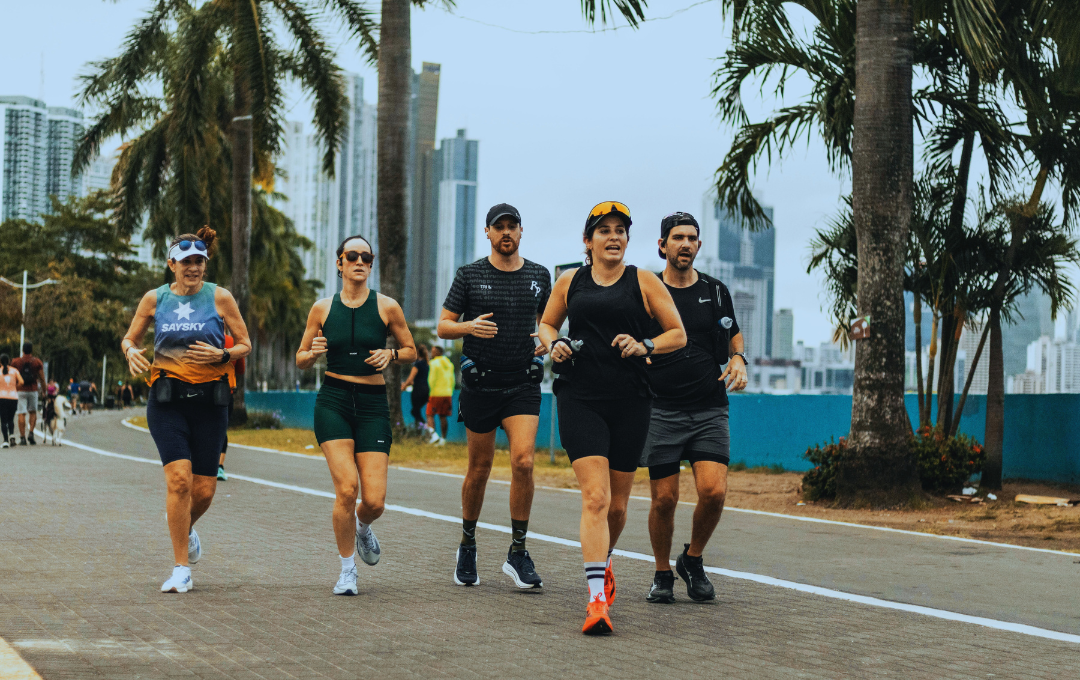
For decades, the standard medical advice for a runner with aching knee joints was to give up the activity and hang up their shoes. People believed that knees had limited “mileage,” and every run was just a step closer to getting a knee replacement.
New research confirms that running does not cause knee joint degradation. Joints are living tissues that adapt and strengthen through movement, rather than deteriorating through use. Studies show that recreational running, up to 25 miles per week, can actually improve joint health by maintaining cartilage hydration and resilience, even for those with osteoarthritis.
When chronic inflammation makes activity feel impossible, genicular artery embolization (GAE) can provide non-surgical knee pain relief. This minimally invasive procedure targets the abnormal blood flow causing joint inflammation. By reducing pain at its source, GAE enables patients to transition from debilitating symptoms into the active rehabilitation required to return to running. To understand why this approach is so effective, let’s look at how GAE actually works to quiet the inflammation in your knee.
Why Your Knees Hurt
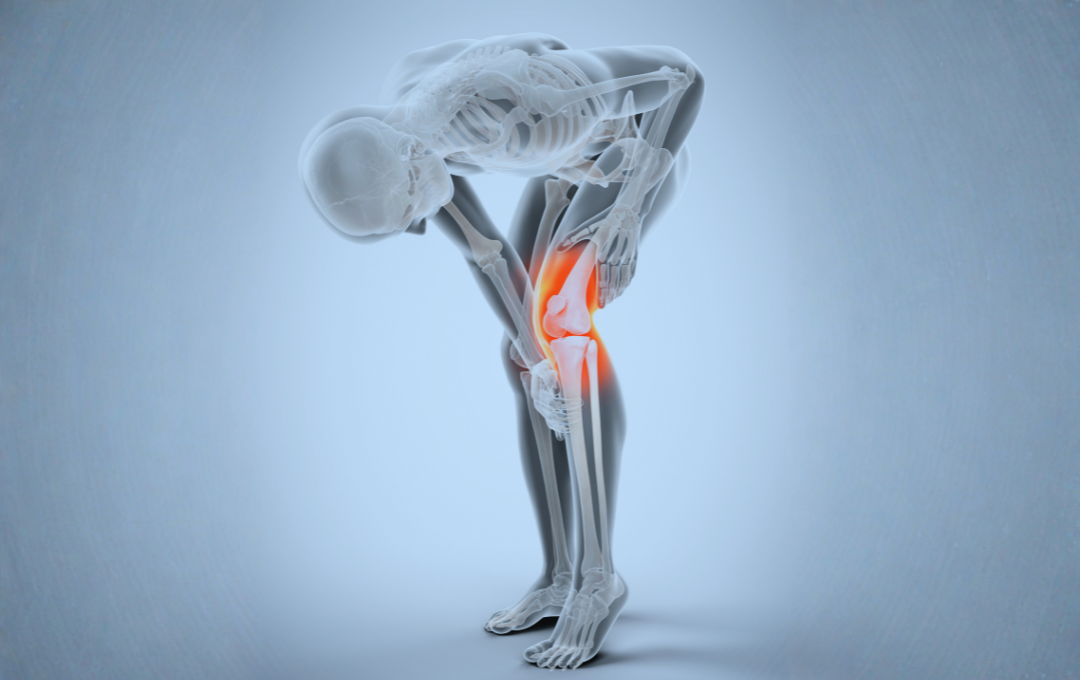
To understand why your knees hurt and how to fix the pain, we first have to redefine what is actually happening inside your joint. Many people think of knee osteoarthritis (OA) as a simple “wear and tear” problem where cartilage just disappears. In reality, OA is a whole joint disease. It affects the bone, the ligaments, and most importantly, the lining of the joint (the synovium), which becomes chronically inflamed.
The reason behind chronic knee pain treatment often involves a process called hypervascularity. When your knee is injured or overworked, the body tries to heal itself by growing a chaotic network of “extra” tiny blood vessels.
While blood flow is usually beneficial, these specific vessels shouldn’t be present; they carry tiny nerve fibers that transmit constant pain signals to your brain. This creates a cycle of chronic inflammation that won’t turn off.
Common Symptoms of Knee Arthritis
The Power of Movement
Contrary to the belief that you must rest to protect your joints, science confirms that they are living tissues that thrive on movement. Cartilage relies on the compression and decompression of walking to circulate nutrients and remove waste, keeping it hydrated and resilient. Furthermore, research consistently shows that running does not increase the risk of joint damage; rather, it strengthens the surrounding musculature, which acts as a protective suspension system. Ultimately, physical activity is essential for joint longevity, as it reinforces your body’s natural defenses against degeneration.
Even if you may have been told to avoid too much movement to save your joints, the science suggests the exact opposite. Your knees are not static parts; they are a living system that requires activity to stay healthy.
Does Walking Help Knee Arthritis?”
Walking and running are essential for joint health because cartilage doesn’t have its own blood supply. Instead, it stays healthy through movement; the pressure from each step squeezes out waste, while lifting your foot allows fresh, nutrient-rich fluid to soak back in. This process keeps the tissue hydrated and strong.
Despite the common fear that running damages the knees, studies show that runners often have healthier joints than inactive people. Regular activity helps manage body weight and strengthens the muscles surrounding your joints. These muscles act as natural shock absorbers, taking the pressure off your bones and preventing long-term wear and tear.
When Exercise Isn’t Enough

If you’ve been managing knee pain, you’ve likely tried the standard “maintenance” options like physical therapy or activity modification. However, when those no longer provide relief, it’s important to understand how different medical interventions actually work within the joint.
Cortisone and Gel Injections. While a cortisone shot can provide rapid relief by suppressing local inflammation, it is typically a temporary solution. There is also a growing clinical concern regarding “rebound pain” and the fact that repeated steroid injections may contribute to cartilage deterioration over time. Similarly, hyaluronic acid (gel) injections focus on lubrication but don’t always address the root cause of the discomfort.
What is GAE?
If traditional injections or physical therapy haven’t worked, genicular artery embolization (GAE) offers a safer, non-surgical knee pain relief alternative. This minimally invasive procedure is designed specifically for those struggling with running with knee osteoarthritis who want to avoid a total knee replacement. By targeting the abnormal blood flow (hypervascularity) that fuels inflammation, GAE reduces the constant throbbing. This procedure creates a window of opportunity, allowing you to finally perform the essential recovery exercises like split squats and weighted lunges that were previously impossible.
How GAE Resets Your Pain:
- Precision Access: Interventional Radiologists guide a tiny catheter to the arteries surrounding the knee.
- Starving Inflammation: By placing microscopic particles to slow excess blood flow, GAE “starves” chronic inflammation at its source.
- No Hospital Stays: Most patients go home the same day and return to light activity shortly after.
- Joint Preservation: GAE focuses on saving and protecting your natural joint rather than replacing it with metal and plastic.
- Lasting Results: This process effectively resets pain signals, providing a long-term solution when medications fail.
The Path Back to the Pavement: Life After GAE

Genicular artery embolization (GAE) acts as a “volume knob” for chronic pain. By cooling down the inflammation in the knee, GAE creates a biological window of opportunity to rebuild the strength that osteoarthritis once made impossible.
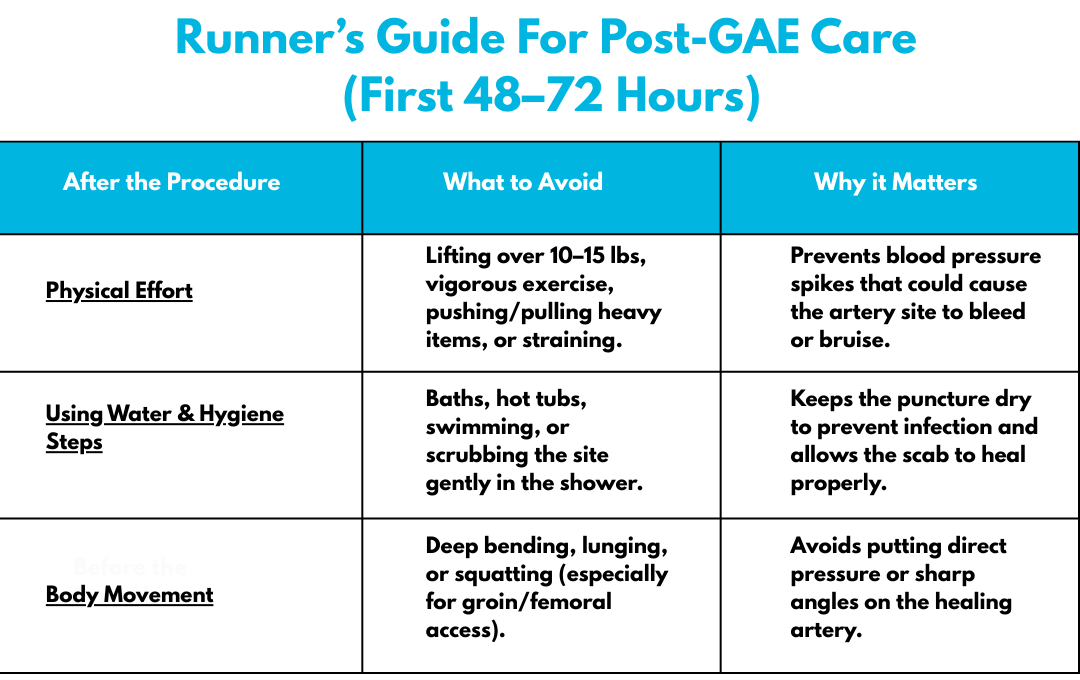
Phase 1: Immediate Mobility
Recovery starts fast. Within days, most patients are back to light walking. The focus is on restoring the range of motion without overtaxing the joint.
- The Towel Squeeze: Place a rolled towel behind the knee crease and gently pull the shin toward you to create joint space and reduce stiffness.
Phase 2: Building Strength
Your muscles are your knee’s shock absorbers. Before GAE, these exercises are often too painful to attempt; post-GAE, they become the foundation of your recovery.
- Split Squats & Step-ups: Essential for quad power and single-leg stability.
- Lateral Step-downs: Targets the soleus and hip stabilizers to prevent joint collapse. This movement strengthens the knee and hip, improves balance, reduces inward knee collapse, and aids in injury prevention for runners and athletes.
Phase 3: The Return to Running
When you’re ready to hit the road, do it strategically:
- Surface Matters: Start on grass or trails to minimize impact.
- The “Listen” Rule: Distinguish between “good” muscle soreness and “bad” joint pain. If the joint flares, return to Phase 2 strength work for a few days.
A New Path for Runners at USA Pain Center

Knee osteoarthritis can feel like a forced retirement, but it doesn’t have to be the finish line for your active lifestyle. The biological reality is that activity is essential for joint health, and GAE is the clinical tool that makes that activity possible again. By silencing the chronic inflammation that once made every step a struggle, you gain the freedom to rebuild your strength and return to the movement you love.
The USA Pain Center helps runners overcome the barriers of running with knee osteoarthritis. We specialize in genicular artery embolization (GAE), a breakthrough non-surgical knee pain relief treatment performed by our expert interventional radiologists.
By using image-guided precision to target the abnormal blood flow fueling your inflammation, GAE “shuts down” the biological root of your pain. This quick, outpatient procedure requires no major surgery and allows you to return home the same day.
Stop managing your decline and start reclaiming your miles. Contact USA Pain Center today to see if GAE is your path back to the pavement.
FAQs
Do I need physical therapy after GAE?
Physical therapy is not necessarily required after GAE, but it is highly recommended. GAE reduces inflammation and pain in your knee and strengthens the muscles that support the joint. A therapist can help you safely build strength and correct any walking habits you developed while you were in pain.
How long will the results of the GAE procedure last?
Most patients maintain lasting relief and an improved quality of life for 1-2 years. However, some long-term studies show that many patients continue to experience relief for 3-5 years, depending on their lifestyle and the severity of their condition
When can I resume running after GAE?
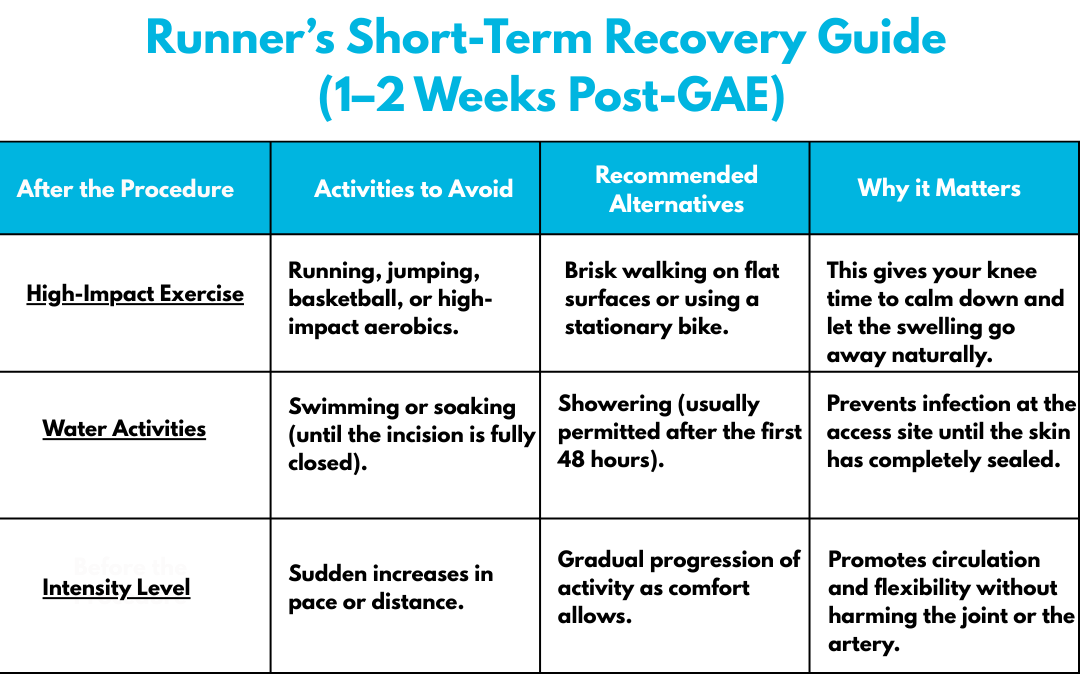
For the first 72 hours, avoid all running to allow the artery to heal securely. Between days 4 and 14, continue to avoid high-impact running or hard surfaces while the knee’s inflammatory response subsides. Most runners can begin reintroducing light jogging on flat surfaces after two weeks, gradually increasing distance as comfort allows.