Medically reviewed by
USA Pain Center Medical Review Team
Interventional radiologists focused on knee arthritis
Date: October 2026
Knee grinding, also called crepitus, often comes from cartilage changes linked to osteoarthritis, and treatment options exist at every stage. If you feel or hear a grating sound when you bend your knee, you are not alone. Some people notice this sign years before they get a diagnosis, and knowing what it means can help you protect your mobility going forward.
What Causes Knee Grinding in Osteoarthritis
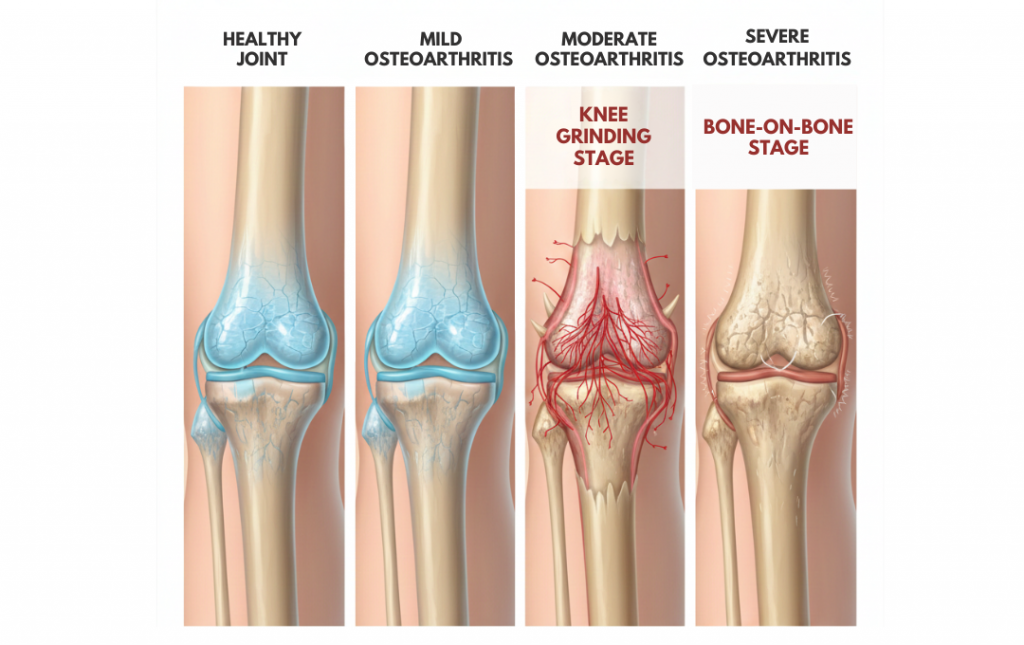
Healthy cartilage is smooth. It cushions the bones in your knee. With osteoarthritis, cartilage slowly wears down and gets rough or pitted. The bones no longer glide quietly. They create the grinding sound known as crepitus.[1]
The sound is not the whole story. Osteoarthritis also makes the knee’s inner lining, the synovium, swell and get inflamed. Tiny, abnormal blood vessels feed this swelling. They bring in more inflammatory cells, which can make the joint more sensitive to pain. So the sound comes from friction, but much of the pain comes from this ongoing inflammation.
Early Cartilage Wear and Tear vs. Bone-on-Bone Grinding
Not all knee grinding means the same thing. In early or moderate osteoarthritis, cartilage is frayed or thin, but a layer still protects the bone. Grinding at this stage tends to be mild and may come and go.
Bone-on-bone grinding is the late stage. Cartilage has worn away completely, so the bones move directly against each other. This grinding is often louder and paired with stiffness, swelling, or a feeling that the knee is not stable. Only a specialist with imaging can confirm which stage you are in.
When Knee Grinding Needs a Specialist’s Attention
Occasional popping with no pain is usually harmless. It often comes from small gas bubbles in the joint fluid.[1] Persistent grinding is different. It is worth having checked by a knee osteoarthritis symptoms specialist if it comes with any of these signs:
- Pain during or after movement
- Swelling or warmth in the joint
- Stiffness that does not ease up after a few minutes
- A feeling that the knee may buckle or give way
Learning more about osteoarthritis of the knee can help you spot these patterns early. Early evaluation usually means more treatment options are open to you.
Treatment Options for Knee Grinding From Osteoarthritis
Conservative Care First
Most specialists start with simple steps. Physical therapy can strengthen the muscles around the knee and may reduce grinding over time. Anti-inflammatory medication and activity changes can calm symptoms for a while. These steps help some people, but they often give only short-term relief once osteoarthritis has moved forward.
Genicular Artery Embolization (GAE)
When conservative care is not enough, genicular artery embolization (GAE) offers another option between everyday care and joint replacement. A specialist guides a thin catheter to the small arteries feeding inflammation in the knee. Tiny particles are placed to reduce blood flow to that tissue. The goal is to calm the inflammation that fuels pain, not just cover it up.
One review of 270 patients and 339 treated knees found a 99.7 percent technical success rate for GAE. Pain and disability scores improved and held up at twelve months.[2]
New Research on GAE (2026)
Research on GAE keeps growing. A study in Radiology, published in October 2026, followed 194 patients treated with a newer particle that dissolves within hours.[3] At twelve months, 80 percent said their pain relief was meaningful in daily life, with mild and short-lived side effects for most. This adds to the evidence that GAE may help some patients manage knee osteoarthritis pain.
GAE Compared to Other Non-Surgical Options
GAE is one of several non-surgical paths for knee pain, and it is not the first step for everyone. Comparing GAE with PRP injections shows the difference. PRP supports tissue healing and tends to fit earlier-stage arthritis. GAE targets the inflammation driving pain and may fit more persistent symptoms. A specialist can review your case and help you weigh which non-surgical option fits best.
Home Care for Knee Grinding
Exercise and Strengthening
Low-impact activity like walking, swimming, or cycling keeps the joint moving without added strain. Strengthening the quadriceps and hip muscles can improve how the kneecap tracks. This may reduce grinding and support joint stability over time.
Vitamins and Joint Nutrition
No vitamin reverses cartilage loss, but a few nutrients are linked to joint health. Vitamin D helps the body absorb calcium for strong bones, and low levels have been linked with more joint discomfort in some studies.[4] Vitamin C supports collagen production, a building block of cartilage. Omega-3 fatty acids, found in fish and flaxseed, are linked with lower inflammation. These work best as part of a healthy diet overall. Talk to a doctor before starting any supplement.
What Not to Do
A few habits can make knee osteoarthritis worse. Do not push through sharp pain during exercise. Do not stay fully inactive for long periods, since stiffness tends to build without gentle movement. Do not skip follow-up care once symptoms feel better. Do not start new supplements or stop prescribed medication without talking to your provider first.
Knee Pain Relief at USA Pain Center
Knee grinding caused by osteoarthritis is common. It is also manageable at every stage. The right evaluation can help you learn whether conservative care, a minimally invasive option like GAE, or a mix of both may fit your case. At USA Pain Center, we provide genicular artery embolization (GAE), a minimally invasive treatment that targets the source of joint inflammation to restore mobility.
USA Pain Center provides care from board-certified interventional radiologists specializing in GAE. As part of a national leader in minimally invasive care, we are dedicated to preserving your natural joints and providing a personalized path to relief. This expertise allows us to provide a safer alternative to traditional surgery, offering the benefits of an outpatient setting with no hospital stay and a much faster recovery time. At USA Pain Center, we are dedicated to providing a personalized path to relief. Contact our team today to schedule a consultation and determine if GAE is the right treatment option for you.
Knee Pain Evaluation
Ready to Understand Your Knee Grinding?
If knee grinding comes with pain, swelling, or stiffness, a specialist evaluation is a good first step. USA Pain Center specialists use advanced imaging and minimally invasive options, including GAE, to target the inflammation behind knee osteoarthritis pain.
Frequently Asked Questions
- Felson DT, et al. “Prevalence of Knee Crepitus and Risk of Symptomatic Knee Osteoarthritis.” Osteoarthritis and Cartilage, 2019. National Library of Medicine.
- “Genicular artery embolization for treatment of knee osteoarthritis pain: Systematic review and meta-analysis.” PMC, 2026.
- Fleckenstein FN, et al. “Genicular Artery Embolization Using Rapidly Resorbable Gelatin-based Microspheres for Osteoarthritis-related Knee Pain.” Radiology, 2026. doi:10.1148/radiol.253312
- National Institutes of Health, Office of Dietary Supplements. “Vitamin D Fact Sheet for Health Professionals.”
Medical disclaimer: USA Pain Center content provides medical education only. It is not a diagnosis or treatment recommendation. Consult a pain management specialist for evaluation.