Medically reviewed by
Aaron Reichman, MD, Interventional Radiologist
Reviewed October 2026
Knee osteoarthritis develops in four stages, and knowing which one you are in helps explain your symptoms and your options. Osteoarthritis is the most common form of arthritis, affecting an estimated 33 million adults in the United States, and the knee is one of the joints it affects most often.[1] As the cartilage that cushions the knee joint wears down, the condition progresses from minor, often unnoticed changes to significant, constant discomfort. Understanding where your knee falls in that progression can help you and your care team decide what steps make sense next.
What Is Knee Osteoarthritis?
Osteoarthritis of the knee is a specific type of arthritis in which cartilage in the knee joint begins to deteriorate. The cartilage loss narrows the space between bones, causing the bones to rub against each other. Overgrowths at the edge of the knee bones, known as bone spurs, may also occur.
Common Symptoms of Knee Osteoarthritis
As the disease progresses, knee osteoarthritis can bring on the following symptoms:
- Aching or throbbing pain
- Swelling or tenderness
- Joint stiffness or instability
- Locking or popping sensations
- Loss of flexibility or range of motion
Understanding the Kellgren-Lawrence Grading Scale
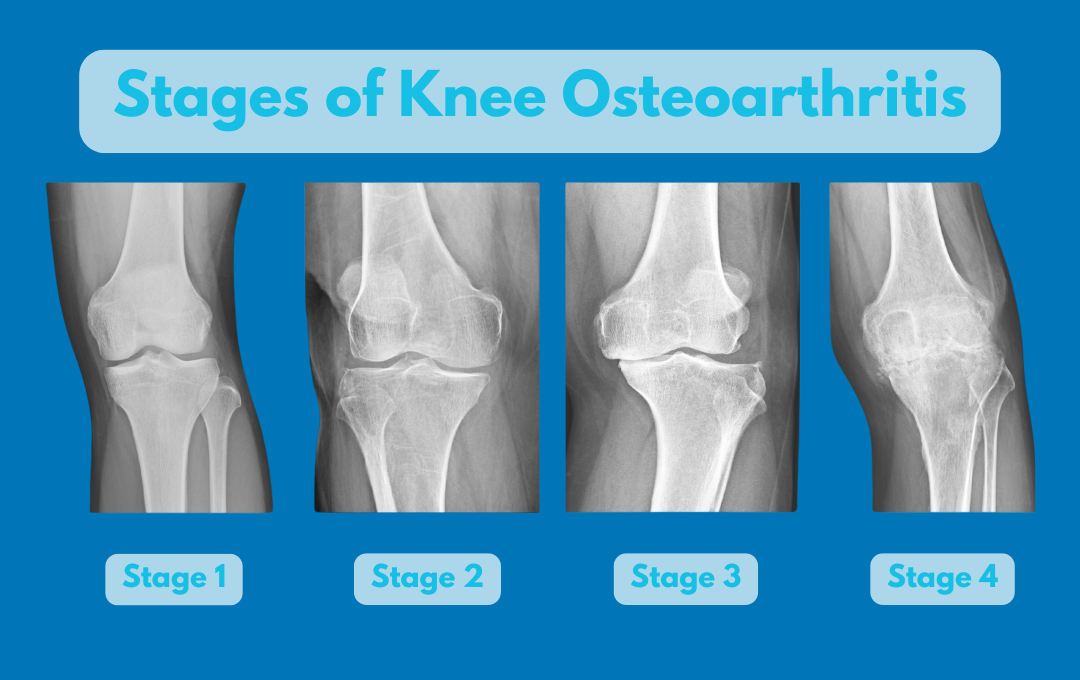
Physicians typically describe knee osteoarthritis severity using the Kellgren-Lawrence grading scale, a system based on X-ray findings.[2] The scale runs from Grade 0, a knee with no visible signs of osteoarthritis, through Grade 4, a knee with severe cartilage loss. Grading looks at a few specific features: the width of the joint space between bones, the presence of osteophytes (bone spurs), and changes to the bone surface itself. This article uses the four main stages patients are usually told about, Stages 1 through 4, which correspond to Kellgren-Lawrence Grades 1 through 4.
Stage 1: Minor Knee Osteoarthritis
Stage 1 is the earliest point at which changes become visible on an X-ray. Cartilage has only just begun to wear, and any bone spur formation is very small.
Symptoms of Stage 1 Knee Osteoarthritis
Most people at Stage 1 feel little to no pain. Some notice brief stiffness after sitting for a while or occasional aching after an unusually active day, but daily activities are rarely affected. Many people do not realize anything has changed in the joint at all.
What Imaging Shows at Stage 1
X-rays at this stage show possible, minor osteophyte formation with the joint space still essentially intact. Because symptoms are so mild, Stage 1 is more often discovered incidentally, such as during imaging for an unrelated knee concern, than through a patient-reported complaint.
Stage 2: Mild Knee Osteoarthritis
By Stage 2, imaging shows more definite bone spur growth, though the joint space usually still looks close to normal.
Symptoms of Stage 2 Knee Osteoarthritis
Stiffness and mild discomfort become more noticeable at this stage, particularly after periods of rest or at the end of an active day. Some people start to notice the knee more during stairs, kneeling, or long walks, though pain is typically intermittent rather than constant.
Staying Active With Stage 2 Knee Osteoarthritis
Gentle, low-impact movement, such as walking, swimming, or cycling, is generally recommended over extended rest at this stage. Movement helps maintain joint mobility and keeps the surrounding muscles strong, which supports the knee. Short rest breaks during flare-ups are reasonable, but long stretches of inactivity tend to make stiffness worse rather than better. Reviewing your knee osteoarthritis causes can also help you identify habits or risk factors worth adjusting early.
Stage 3: Moderate Knee Osteoarthritis
Stage 3 marks a clearer turning point. Cartilage loss becomes more substantial, and the joint space narrows further on imaging.
Symptoms of Stage 3 Knee Osteoarthritis
Pain at Stage 3 tends to be more frequent and more noticeable during everyday movement, including walking, bending, and climbing stairs. Swelling after activity becomes more common, and stiffness after sitting may take longer to ease. Some people also notice a grinding or catching sensation as the joint moves.
How Stage 3 Affects Daily Movement
Because pain and swelling are more consistent at this stage, daily tasks like standing for long periods, squatting, or carrying groceries can become harder to manage comfortably. This is often the point where conservative measures alone start to feel less effective, which is why many patients begin exploring additional options around Stage 3.
Stage 4: Severe (End-Stage) Knee Osteoarthritis
Stage 4 is the most advanced point on the Kellgren-Lawrence scale and is often referred to as bone-on-bone knee arthritis, since the cartilage that once cushioned the joint has worn down significantly or nearly completely.[3]
Symptoms of Stage 4 Knee Osteoarthritis
Stage 4 typically involves more constant pain, including discomfort that may continue even at rest or disrupt sleep. Stiffness is more persistent, swelling is common, and many people notice a reduced range of motion along with a grinding sensation during movement. Daily activities such as walking, climbing stairs, or standing from a seated position often become more difficult.
What Makes Stage 4 “End-Stage” Knee Osteoarthritis
“End-stage” describes the point on the grading scale where cartilage loss is at its most advanced and joint space is severely narrowed or gone. It is a description of what imaging shows, not a prediction of how much pain any individual will have. Research has clarified that joint inflammation, not cartilage loss alone, contributes substantially to pain at this stage, which has implications for which treatments may help. You can read more detail in our overview of bone-on-bone knee arthritis.
Walking With Advanced Knee Osteoarthritis
Complete inactivity is generally not recommended at Stage 4, since avoiding movement allows the muscles supporting the knee to weaken over time. Gentle, low-impact movement, paced to your comfort level and ideally guided by a physical therapist or specialist, is usually a better approach than prolonged rest.
Treatment Options by Stage of Knee Osteoarthritis
Treatment approaches generally shift as the stages progress, though the right option always depends on an individual evaluation rather than the stage number alone. Various treatment options address pain and swelling from osteoarthritis in the knee. The best treatment for you will depend on the extent of your condition.
| Treatment Options | Stage(s) |
| Lifestyle changes, physical therapy, weight management | 1 |
| Medications, steroid injections | 1, 2, 3 |
| Genicular artery embolization (GAE) | 2, 3, 4 |
| Knee replacement surgery | 4 |
Conservative Care for Early Stages
At Stages 1 and 2, treatment often starts with weight management, activity modification, and physical therapy. These approaches can help manage mild symptoms and may help slow how quickly the condition progresses, though they do not reverse existing cartilage wear.
Minimally Invasive Options for Moderate to Advanced Stages
When conservative care is no longer providing enough relief, typically somewhere between Stage 2 and Stage 4, some patients explore genicular artery embolization (GAE). GAE is a minimally invasive, image-guided procedure that targets the blood vessels associated with joint inflammation. It may help reduce knee pain in appropriate candidates and is performed on an outpatient basis. Many patients who explore GAE are navigating what is sometimes called the knee osteoarthritis treatment gap, the space between treatments that have stopped working well and a joint replacement they are not ready for.
When Knee Replacement May Be Considered
Knee replacement is a major surgery generally reserved for advanced cases, often Stage 4, where other options have not provided sufficient relief. It involves significant recovery time and is not the right fit for every patient or every stage of knee osteoarthritis. A pain management specialist can help you understand where your symptoms and imaging place you, and which early signs of knee arthritis you may have overlooked are worth discussing before considering surgery. Your specialist may also recommend imaging to evaluate knee arthritis to confirm your current stage before recommending next steps.
Knee Osteoarthritis Evaluation
Ready to Understand Your Stage of Knee Osteoarthritis?
Knowing your Kellgren-Lawrence grade is a helpful starting point, but it does not tell the whole story. Pain, mobility, and daily function vary widely between people at the same stage, which is why a specialist evaluation matters more than the number alone.
USA Pain Center specialists use advanced imaging and minimally invasive techniques to evaluate knee osteoarthritis at every stage and discuss whether options like genicular artery embolization may be appropriate for you.
FAQs About the Stages of Knee Osteoarthritis
- Theis KA, Murphy LB, Guglielmo D, et al. “Prevalence of Arthritis and Arthritis-Attributable Activity Limitation, United States, 2019-2021.” MMWR Morb Mortal Wkly Rep. 2023;72(40):1101-1107. Centers for Disease Control and Prevention.
- Kellgren JH, Lawrence JS. “Radiological assessment of osteo-arthrosis.” Annals of the Rheumatic Diseases. 1957;16:494-502. As referenced in Kohn MD, et al., Classifications in Brief: Kellgren-Lawrence Classification of Osteoarthritis, National Institutes of Health (PMC).
- National Institute of Arthritis and Musculoskeletal and Skin Diseases (NIAMS). “Osteoarthritis.” National Institutes of Health.
Medical disclaimer: USA Pain Center content provides medical education only. It is not a diagnosis or treatment recommendation. Consult a pain management specialist for evaluation.