
If you’re living with that persistent, painful knee grinding, clicking, or chronic swelling, you know it’s more than just a noise. These issues often manifest as a sharp popping sensation or a gritty grinding sensation (crepitus) while climbing stairs or bending down. These symptoms are often accompanied by stiffness and a lingering dull ache.
While physical therapy, nonsteroidal anti-inflammatory drugs (NSAIDs), and steroid injections are common starting points, they often provide only short-term relief. For those seeking an alternative between conservative care and surgery, genicular artery embolization (GAE) offers a minimally invasive solution. Knowing the underlying cause of your knee pain is the first step in determining if nonsurgical GAE is the right fit for your recovery.
Understanding Osteoarthritis: Why Do Knee Bones Grind?
To understand why your knees make a grinding sound, we have to look at what’s happening inside the joint.
The Cartilage Breakdown
Healthy cartilage acts as a slippery, rubbery shock absorber. In a healthy knee, bones glide over each other silently. However, osteoarthritis is more than just “wear and tear.” It is a degenerative process where the cartilage thins and roughens. This leads to knee grinding (medically known as crepitus), a literal sensation of bone-on-bone friction or rough cartilage rubbing together.

The Pain Mechanism: Targeting Inflammation
While the sound comes from the structural friction within the joint, the pain is often driven by inflammation. Chronic osteoarthritis causes the synovium (the lining of the knee) to become inflamed. This process is fueled by neovascularization—the growth of abnormal, tiny new blood vessels supplied by the genicular arteries.
These extra blood vessels carry more inflammatory cells to the joint, heightening pain sensitivity. Therefore, effective grinding knee treatment is required to address this underlying inflammatory “fuel” at its source.
Learn More About Knee Arthritis
What is Knee Grinding?
Knee grinding, or crepitus, is the audible or physical sensation of friction within the joint. It essentially describes a symptom—the “crunchy” noise you hear when squatting or the vibration you feel when placing a hand on your kneecap. While grinding is a main sign of osteoarthritis, it is important to distinguish between early-stage friction and the more advanced “bone-on-bone” stage.
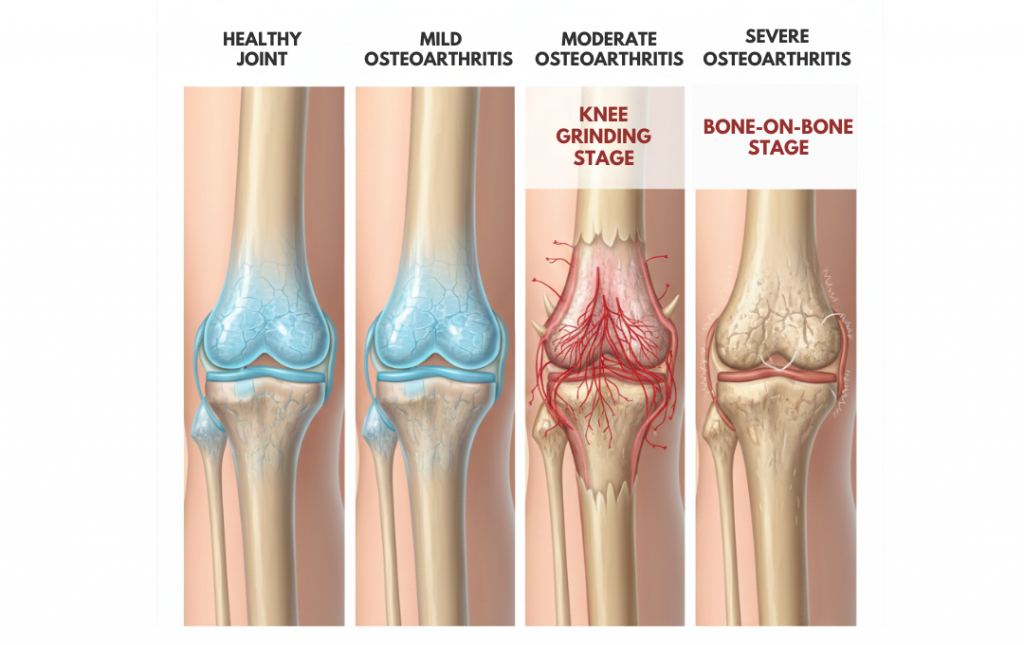
In the early to moderate stages of osteoarthritis, grinding occurs because the once-smooth cartilage has become frayed or pitted. However, a layer of protective tissue remains. In contrast, bone-on-bone arthritis is the end stage of the disease, in which the cartilage has completely worn away.
Are Knee Popping and Knee Grinding the Same?
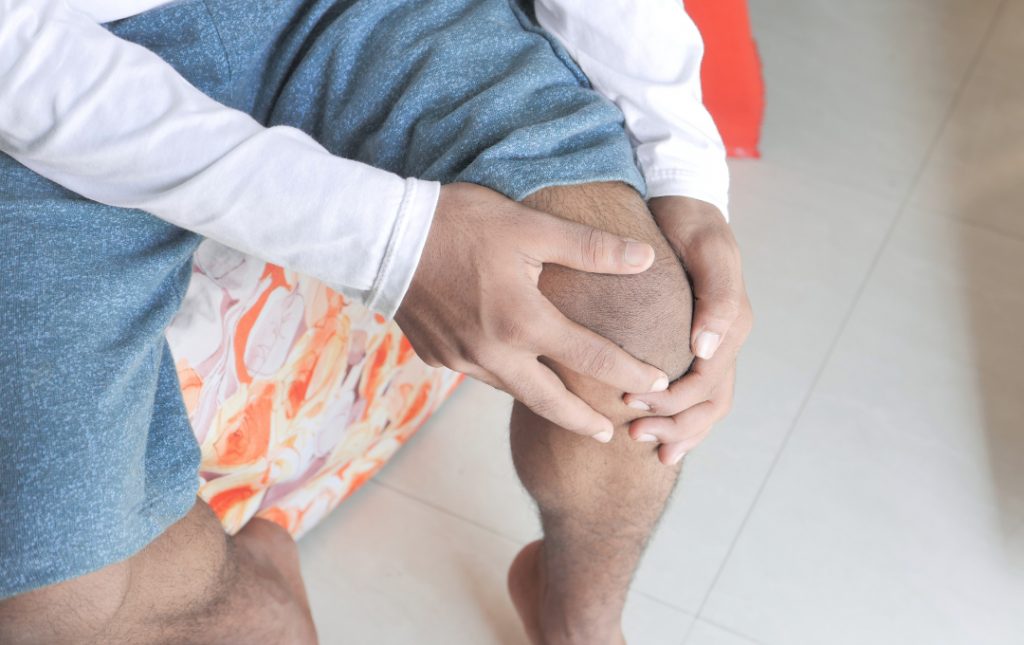
Many people wonder if the occasional popping sensation in their knee is related to the chronic grinding sensations often associated with osteoarthritis. While both involve joint noise, they are distinct sensations with different underlying causes.
- Knee popping: Often harmless gas bubbles or ligaments.
- Knee grinding: Persistent friction indicating structural changes.
Is Knee Grinding Painful?
While the sensation of knee grinding (crepitus) can be uncomfortable, it isn’t always a source of immediate knee pain. For some, that “crunchy” feeling is simply a mechanical byproduct of the joint moving, occurring without any physical distress. However, when this grinding is a symptom of progressive osteoarthritis, the friction is usually a warning sign that the joint is under stress.
This grinding is frequently accompanied by a dull, persistent ache, visible swelling or internal inflammation, and a noticeable loss of flexibility or stiffness, especially first thing in the morning. While an occasional pop might be a normal part of joint mechanics, consistent grinding is a key indicator of osteoarthritis and usually requires medical evaluation to prevent further joint degradation.
What is Genicular Artery Embolization (GAE)?
Genicular Artery Embolization (GAE) is a minimally invasive, image-guided procedure performed by an interventional radiologist. Unlike surgery, it doesn’t involve cutting into the joint or replacing parts.
How it Works:
- Access: A tiny catheter is inserted through a pinhole incision, usually in the wrist or groin.
- Navigation: Using real-time X-ray guidance, the doctor steers the catheter to the inflamed genicular arteries.
- Embolization: Microscopic particles (the size of sand grains) are injected to safely block the abnormal, inflammatory blood flow.
- The Result: By “pruning” these excess vessels, GAE reduces inflammation, significantly decreasing pain and swelling
GAE vs. Traditional Treatments
| Treatment Type | How it Works | Pros/Cons |
| Pain Medication/NSAIDs | Exercises and pills. | Good first step; often temporary. |
| Injections | Cortisone or Hyaluronic Acid. | Temporary relief (3–6 months); wears off. |
| GAE (Embolization) | Blocks inflammatory blood flow. | Minimally invasive; long-lasting; no hospital stay. |
| Knee Replacement | Major surgery to replace the joint. | Effective for severe cases; requires months of recovery. |
Who is an Ideal Candidate for GAE?
The ideal candidate for GAE includes patients with mild to moderate knee arthritis pain. You might be an ideal candidate if you:
- Have persistent, localized knee pain that interferes with daily life.
- Have tried medications or injections with little to no success.
- Are seeking a non-surgical option to delay or avoid a total knee replacement or maybe ineligible for major surgery due to age and other health conditions.
However, it is important to know that GAE is generally not recommended for those with advanced, “end-stage” bone-on-bone disease or severe physical deformities.
What to Expect: The GAE Journey
Understanding the GAE process and knowing what to expect can ease the anxiety of starting a new treatment. This non-surgical procedure is designed to restore mobility and provide lasting relief without the recovery demands of major surgery.
From your initial diagnostic imaging to when you walk out of the clinic, here is a step-by-step look at what you can expect during the GAE process.
- Before: You’ll have a consultation and imaging (like an MRI) to confirm the inflammation.
- During: The procedure is performed in an outpatient setting and takes 1–2 hours. You are kept comfortable with “twilight sedation”, meaning you remain conscious but deeply relaxed throughout the procedure.
- After: You go home the same day with just a small bandage. Most patients return to regular activities within days.
- Results: While some feel immediate relief, pain typically begins to fade significantly within 1–3 weeks and continues to improve for up to 6 months.
Knee Pain Relief at USA Pain Center

Knee grinding and popping do not necessarily require a total knee replacement. At USA Pain Center, we provide genicular artery embolization (GAE), a minimally invasive treatment that targets the source of joint inflammation to restore mobility.
USA Pain Center provides care from board-certified interventional radiologists specializing in GAE. As part of a national leader in minimally invasive care, we are dedicated to preserving your natural joints and providing a personalized path to relief. This expertise allows us to provide a safer alternative to traditional surgery, offering the benefits of an outpatient setting with no hospital stay and a much faster recovery time. At USA Pain Center, we are dedicated to providing a personalized path to relief. Contact our team today to schedule a consultation and determine if GAE is the right treatment option for you.
Schedule Your Consultation Online