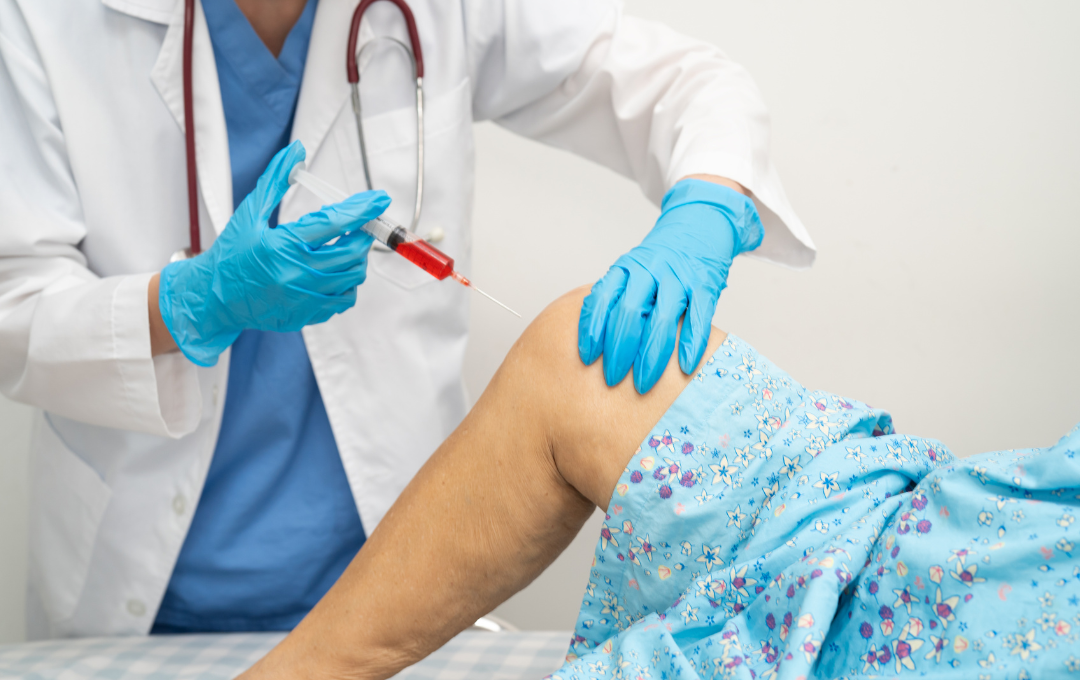
You scheduled your appointment, braced for the needle, and received cortisone shots in the knees with one goal: improving your mobility. Perhaps it worked for a month, or maybe you felt no change at all. When the pain returns, sometimes even sharper than before, it leaves many patients wondering, “What should I do if a cortisone shot doesn’t help my knee?”
While steroids have been the standard knee pain treatment for decades, they often prove to be a temporary mask rather than a cure. If you are seeking knee pain treatment options, you may wonder why cortisone shots in the knees provide temporary relief and why “more shots” often fail.
Common Symptoms of Knee Arthritis
Why Cortisone Fails for Knee Arthritis
The primary reason cortisone shots in the knee fail to provide long-term relief is that they only address the “smoke,” not the “fire.” Cortisone is a powerful anti-inflammatory drug, but it does not reverse the biological changes occurring within an arthritic joint.
In degenerative joint disease of the knee, commonly known as knee osteoarthritis (OA), the joint environment is continually breaking down. While a steroid can temporarily quiet the immune response, it doesn’t stop the underlying wear and tear. In fact, research suggests that repeated cortisone shots in the knees can accelerate the very damage you are trying to treat.
Addressing Inflammation vs. Mechanical Wear
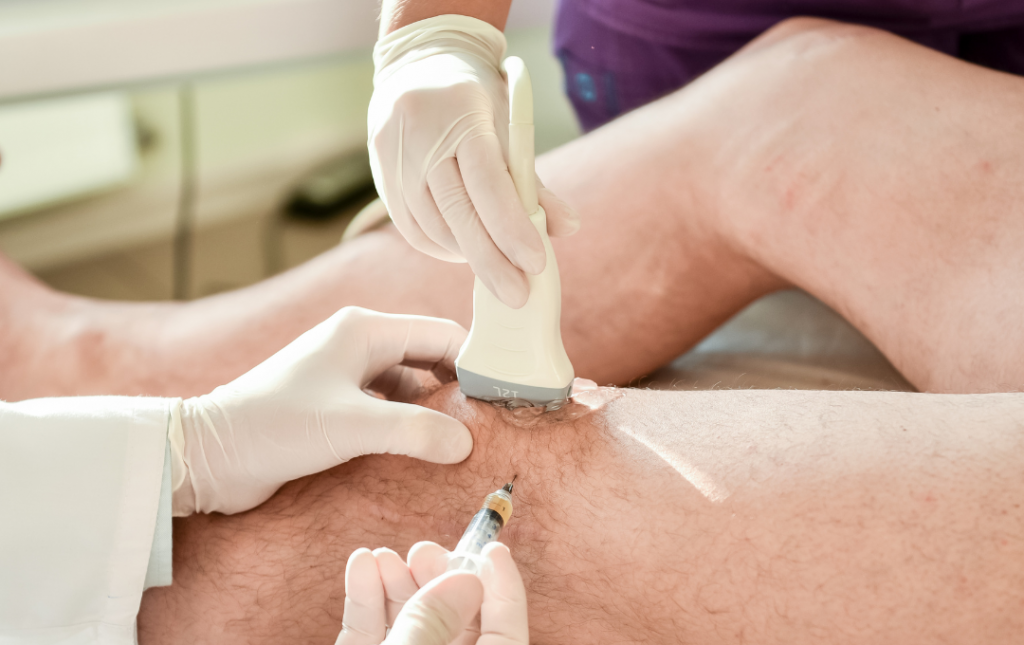
To understand failed knee injection reasons, we need to distinguish between two types of pain:
- Inflammation: The swelling and heat associated with knee inflammation from arthritis.
- Mechanical Knee Pain: This is the structural grinding, bone-on-bone contact, and structural instability.
Cortisone shots in the knees are intended solely to treat inflammation. If your pain is driven by structural issues or “mechanical” wear and tear, the steroid will likely fail.
The “Half-Life” Problem
Patients frequently ask: How long do cortisone shots in the knee last? On average, relief lasts between 6 to 12 weeks. Since the body metabolizes the drug, the underlying knee osteoarthritis (OA) remains, and the pain inevitably returns once the chemical cortisone wears off.
The Vascular Root Cause
New medical insights show that the root cause of knee pain often involves “hypervascularity”—the growth of tiny, abnormal blood vessels in the joint lining (synovium). These vessels bring along new nerves that are hypersensitive to pain. Steroids cannot remove these vessels, which is why cortisone injections are not working for knee pain in many chronic sufferers
The Hidden Risks: Cortisone Shots in the Knee Side Effects
Many patients are surprised to learn that steroids carry significant long-term side effects.
Do cortisone shots cause cartilage damage?
While cortisone shots provide rapid pain relief, they can cause cartilage damage through a process called chondrotoxicity. Research indicates that the steroid can suppress the cells responsible for repairing joint tissue, leading to cartilage thinning and weakened ligaments over time.
Can cortisone shots make knee arthritis worse?
While a single injection is generally considered safe, repeated shots in the same joint can accelerate the progression of osteoarthritis.
Since the medication also masks pain, there is an added risk of overexerting the joint before it has truly healed, further contributing to structural breakdown. By thinning the protective cartilage faster than the natural progression of the disease, repeated shots may actually bring you closer to a complete knee replacement sooner.
Common Adverse Effects of Cortisone
Beyond cartilage loss, patients should be aware of other cortisone shots in the knee side effects, including:
- Steroid Flares: A temporary increase in pain and swelling for 48 hours post-injection.
- Skin Thinning: Whitening or thinning of the skin around the injection site.
- Blood Sugar Spikes: A significant concern for diabetic patients.
- Infection Risks: Every entry into the joint space carries a small but serious risk of septic arthritis.
When Cortisone Shots Fail
Even if you are dealing with failed knee injection reasons, you aren’t out of options. There are several alternatives to cortisone shots in the knees:
- (Platelet-Rich Plasma (PRP) Injections: PRP uses your own blood’s healing factors to modulate the joint environment, typically lasting longer than steroids.
- Physical Therapy: Specialized physical therapy for knee pain after failed injections can strengthen supporting muscles, reducing mechanical load on the damaged joint.
- Lifestyle Modifications: Weight management and low-impact exercises help support knee osteoarthritis treatment alternatives.
- Minimally Invasive Treatment, such as genicular artery embolization.
Genicular Artery Embolization (GAE): A Breakthrough for Chronic Pain
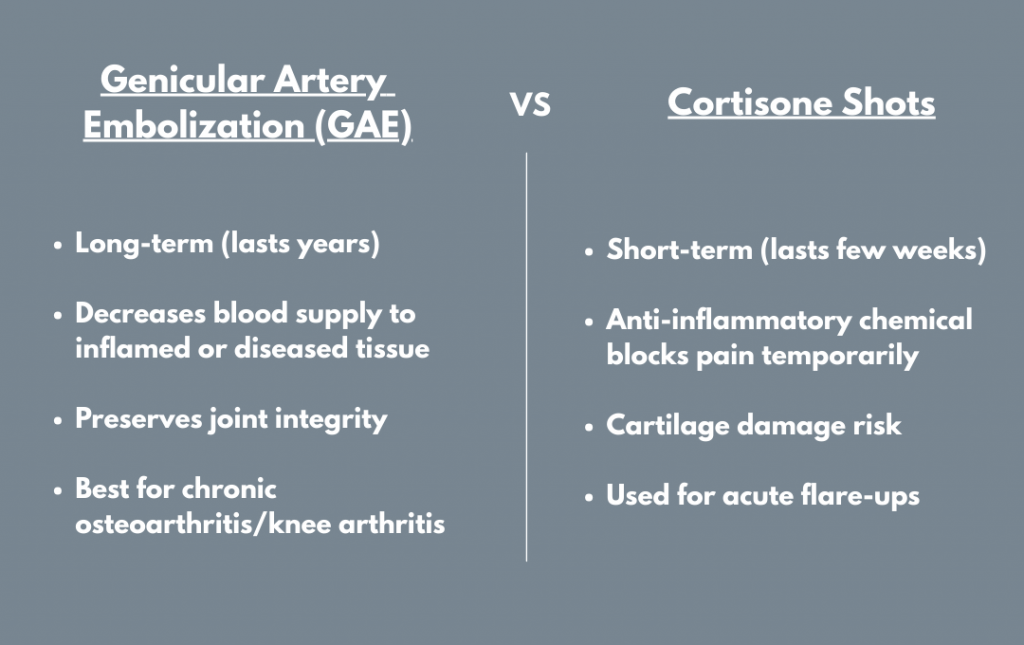
If you’ve tried shots and physical therapy with little success, genicular artery embolization (GAE) offers long-term pain management. GAE is a minimally invasive, non-surgical treatment used to reduce chronic knee pain caused by osteoarthritis.
It strategically blocks small blood vessels to reduce excess blood flow and inflammation in the knee joint. This procedure offers a long-term solution for patients who haven’t found relief through physical therapy or medication and wish to avoid total knee replacement.
How GAE Works:
Interventional radiologists use a tiny catheter to reach the arteries supplying the knee. By placing small particles to slow excess blood flow, chronic inflammation is “starved” at its source, effectively resetting pain signals in the joint.
Knee Pain Treatment with USA Pain Center
USA Pain Center offers genicular artery embolization (GAE) as an advanced minimally invasive alternative to knee replacement and other treatments for OA and knee arthritis.
Instead of replacing the joint, our board-certified specialists use precise, image-guided technology to reduce inflammation that makes daily movement difficult. This outpatient approach requires no hospital stay and minimal downtime, offering a path to long-term relief for those who haven’t found success with traditional injections. Our goal is to help you preserve your natural knee and reclaim your active lifestyle through expert care and a significantly faster recovery.
Contact our clinic today to evaluate your candidacy for GAE and find a solution for lasting relief.